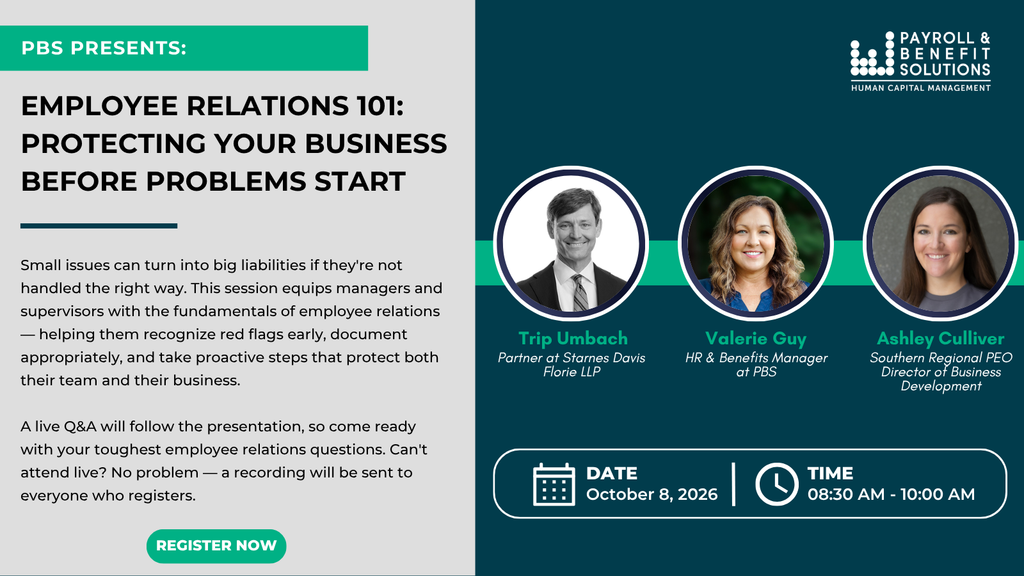

Employee Relations 101 – Protecting Your Business Before Problems Start
October 9, 2026
Ashley Culliver (PBS PEO), Valerie Guy (PBS PEO Services), and Trip Umbach (Starnes Davis & Florie) discuss how managers and employers can recognize employee relations red flags, document concerns, handle terminations and leave issues, and involve HR or legal support before small workplace issues become costly claims.
Employee Relations Foundations
Managers are the front line
- Employee relations is the day-to-day management of conflicts, expectations, fairness, and communication.
- HR builds the policy, but managers apply it in routine decisions and real conversations.
- Small conversations handled well can prevent larger issues from becoming formal case files.
- Takeaway: Train managers to apply policies consistently and recognize when a conversation needs HR support
Red flags should promot curiosity, not assumptions
- Changes in performance, conduct, attendance, or interpersonal behavior may signal a deeper issue.
- Ask whether the issue could involve a skills gap, workload problem, personal matter, medical condition, leave need, or accommodation.
- An employee does not have to use exact words such as FMLA or ADA for legal obligations to be triggered.
- Takeaway: Treat red flags like a smoke detector: notice them early, ask neutral questions, and respond before the issue grows.
Documentation is both coaching and protection
- Write down facts promptly: who was involved, what happened, when it happened, who witnessed it, and what follow-up is expected.
- Avoid vague notes such as “bad attitude.” Specific, timely documentation is easier to defend.
- Apply documentation practices consistently across employees to avoid claims of unequal treatment.
- Takeaway: Documentation should support coaching and accountability, not feel like a case is being built against one person.
Risk areas to review
Escalate issues before they become legal problems
- Bring HR in immediately for allegations of harassment, discrimination, retaliation, threats, safety concerns, or conduct that feels unsafe.
- Escalate situations involving possible protected leave or disability accommodation.
- Complaints involving HR, senior leadership, or ownership may require an outside investigator or neutral reporting channel.
- Takeaway: When you are unsure whether documentation is enough, escalate early.
Terminations require planning and consistency
- Run a risk assessment before termination: documentation, prior warnings, consistency, protected activity, medical or leave history, timing, and final paycheck rules.
- Employees should not first learn they are underperforming during the termination meeting.
- Keep the stated reason consistent across termination letters, unemployment responses, personnel forms, and later agency or legal proceedings.
- Takeaway: Do not “say grace over a termination” at the last minute; plan the decision before taking action.
Leave, accomodations, adn compliance need clear processes
- Train frontline supervisors to recognize potential FMLA, ADA, medical leave, and accommodation cues the moment they surface.
- Use medical certifications and recertifications when the law allows, and follow a consistent interactive process.
- Review I-9 practices, worker classification, wage deductions, and anti-discrimination training as part of regular compliance maintenance.
- Takeaway: Policies matter, but manager training, timely escalation, and internal audits help keep the business protected.
Manager’s Checklist
- Notice the behavior — don’t wait for a pattern to be undeniable.
- Apply the same standard to every employee, every time.
- Have the conversation privately, promptly, and specifically.
- Loop in HR when it involves safety, harassment, or leave.
- Write it down the same day — dates, quotes, observed facts.
- Follow up — confirm the expectation was understood.